About Us
Learn How JB Duke Established the Duke Endowment

Fulfilling a Legacy

The work of The Duke Endowment is founded in the visionary genius and innovative legacy of James Buchanan Duke, one of the greatest industrialists and philanthropists of the 20th century. Below, you can read more about the Duke family and The Duke Endowment through an interactive timeline.

1856 Birth of James B. Duke

James Buchanan "Buck" Duke is born on December 23 to Washington and Artelia Roney Duke on a North Carolina farm.

  1. 1856_Washington_Duke_SM J.B.'s father, Washington, instilled in his sons a sense of responsibility and perserverance. The son of a farmer, Washington was influenced as a boy by Methodist circuit riders who preached near his home and visited his family.
    btn_view_larger btn_download
  2. 1856_Artelia_Duke_SM When J.B. is 2 years old in 1858, his brother, Sydney, and his mother, Artelia, die from typhoid fever. "Telia" Duke is remembered as a beautiful woman, full of kindness and integrity. With no mother to raise him, J.B. is taken in by relatives after his father is drafted into military service during the Civil War. Photo courtesy of Elon University.
    btn_view_larger btn_download
  3. 1856_Duke_homesteaed_SM The Duke Homestead near Durham, N.C., where Buck was born. Now well-preserved as a historic site, the home consists of four rooms with a kitchen addition. Photo courtesy of North Carolina Collection, Durham County Library.
    btn_view_larger btn_download
1865 Modest Beginnings of a Family Business
James B. Duke's father, Washington, returns from the Civil War possessing only his farm, two blind mules, a storehouse of dried tobacco and 50 cents. Washington and his sons James B. Duke and his older brother, Benjamin Newton Duke, launch a small family business selling tobacco. It prospers and the Duke family moves to the growing city of Durham to open an expanded tobacco processing factory.
  1. 1865_Washington_tobaccobarn_SM Washington Duke and the barn at the Duke Homestead where his family's tobacco business was born. Photo courtesy of North Carolina Collection, Durham County Library.
    btn_view_larger btn_download
  2. 1865_tobacco_bag_SM The business grows slowly at first, with the Dukes selling small pouches of tobacco from the back of a wagon.
    btn_view_larger btn_download
1880s Pioneering Mass Production

In 1881, J.B. Duke and his brother Ben, form the W. Duke Sons & Company tobacco enterprise. They are the first to shift production from hand-rolled cigarettes to mechanized mass production in 1885.

  1. 1880_cigarette_factory_SM

    The Durham plant in 1883 where cigarettes were "made by the millions." Photo courtesy of North Carolina Collection, Durham County Library.

    btn_view_larger btn_download
  1. 1880_bonsack_machine_SM

    The Bonsack cigarette-making machine, invented by a man in Virginia, helps W. Duke, Sons and Company increase production after it is installed in the company's Durham factory in 1885.

    btn_view_larger btn_download
  1. 1880_bonsack_machine_SM

    In 1884, J.B. expands the business to New York and opens a small tobacco factory near the Bowery.

    btn_view_larger btn_download
1890s Expanding Business and Philanthropy

James B. Duke establishes the American Tobacco Company in 1890, which becomes the largest tobacco company in the world.

James B. Duke and his brother, Ben, work together in business and in philanthropy. Their sister, Mary Duke Lyon, is an early partner in the family endeavors. With the family's influence and support, Trinity College opens a Durham campus in 1892. In 1896, the Dukes establish a $100,000 endowment for the school with the requirement that women be admitted "on equal footing with men."

  1. 1890_JB_cigar_SM

    J.B. Duke enjoys time off from his business. Photo courtesy of North Carolina Collection, Durham County Library.

    btn_view_larger btn_download
  1. 1890_Mary_Duke_Lyon_SM J.B.'s sister, Mary Duke Lyon, possesses strong business capabilities and contributes to the family business. She died in 1893 at the age of 39.
    btn_view_larger btn_download
  2. 1890_Trinitycampusearly1900s_SM Trinity College, later to become Duke University, in its early days, 1911.
    btn_view_larger btn_download
  3. 1890_Trinitywomen_SM In the late 1890s, Trinity College opens its doors to women with the Dukes' encouragement. At the time, the idea of coeducation had not yet taken hold in much of the country.
    btn_view_larger btn_download
1900s New Business Interests and a Marriage

J.B. and Ben Duke become intrigued by the potential of the fledgling hydroelectric power industry. The brothers acquire land and water rights along the Catawba River and build the Great Falls generating plant. In 1904 and 1905, Catawba Power Company and Southern Power Company (later Duke Power) are founded. In 1907, J.B. marries Nanaline Holt Inman.

  1. 1900_JBandben_SM J.B. learns a great deal about philanthropy from his older brother, who guided much of the family's charitable giving, based on patterns established by their father, Washington.
    btn_view_larger btn_download
  2. 1900_greatfalls_hydroelectric_plant_SM The inauguration of the Duke Power Company plant at Great Falls, S.C., in 1905. Today, Duke Energy delivers electric power to about 4 million customers in the United States.
    btn_view_larger btn_download
  3. 1900_NanalineHoltInman_SM James B. Duke's wife, Nanaline Holt Inman, a widow from Georgia.
    btn_view_larger btn_download
1910s Building Hydroelectric Power and Doris Duke Is Born

In 1911, the American Tobacco Company is broken into several companies through anti-trust action and the Duke brothers shift their interests to the electric power industry. In 1912, Doris Duke is born, the only child of J.B. and Nanaline Duke.

  1. 1910_MountianIsland_SM A view of the Mountain Island Power Plant near Charlotte. Duke Power Company builds the dam at Mountain Island to power electricity through the station, which is still in operation today.
    btn_view_larger btn_download
  2. 1910_JBDukeandDoris1913_SM James B. Duke and his daughter, Doris, c. 1913. Born when Mr. Duke was already 56, Doris shares a strong bond with her father. Photo courtesy of Doris Duke Charitable Foundation Archives.
    btn_view_larger btn_download
1924 James B. Duke Founds The Duke Endowment

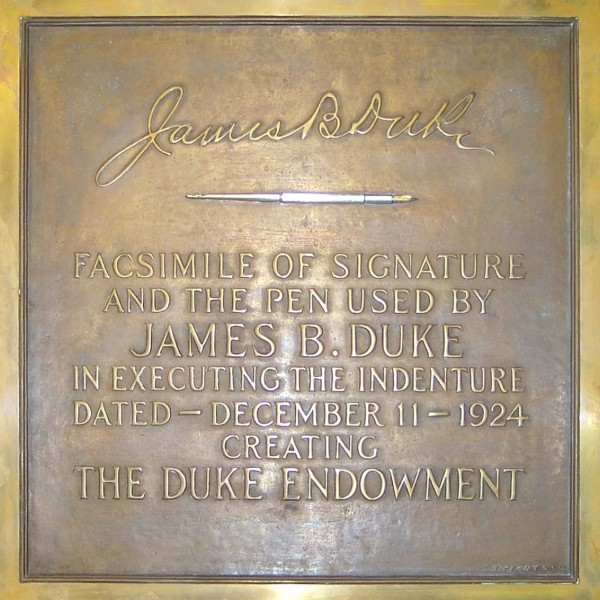
On December 11, J.B. Duke signs the Indenture of Trust (pdf), establishing The Duke Endowment with an initial gift of $40 million.

  1. 1924_Indenture_SM The original Indenture of Trust, bronzed in 1925. In establishing The Duke Endowment, J.B. Duke builds on the foundation of giving that had been established by his father, Washington, and carried on by his older brother, Ben.
    btn_view_larger btn_download
October 10, 1925 James B. Duke Dies

Mr. Duke died unexpectedly on October 10, 1925. Although he became ill from unknown causes, doctors discovered in September that he suffered from what they diagnosed as pernicious anemia, a disease for which there was no known cure at the time. He would have been 69 years old on December 23. In his will, he left the Endowment an additional $67 million.

  1. 1925_JB_funeral_SM

    Pallbearers at the funeral of James B. Duke.

    btn_view_larger btn_download
  1. 1925_sarcophagus_SM

    James B. Duke is buried beside his father in the family mausoleum in Maplewood Cemetery in Durham. After Duke University Chapel was completed in the early 1930s, his remains, along with his father and brother, are moved to three sarcophagi in the church's Memorial Chapel.

    btn_view_larger btn_download
1930s Building Community Hospitals

During the Great Depression, The Duke Endowment funds the construction of dozens of community hospitals in North Carolina, establishing a national model for rural health care. In addition, the "Summer Preacher Program" is created to offer Duke Divinity School students opportunities to serve and train in rural churches. Endowment grants, in some cases, help institutions keep their doors open during the Depression.

  1. 1930_patientinbed_SM Endowment grants help many institutions keep their doors open during the Depression.
    btn_view_larger btn_download
  2. 1930_St_AgnesHospital_SM Through J.B. Duke's philanthropy, he sought to educate physicians, improve the quality of care and increase access to health care in the Carolinas.
    btn_view_larger btn_download
  1. 1930_St_AgnesHospital_SM

    Duke University School of Religion, Class of 1931-32.

    J.B. Duke often told his friends that he owed his success to his “daddy and the Methodist Church.” According to J.B., “My old daddy always said that if he amounted to anything in life it was due to the Methodist circuit riders who frequently visited his home and whose preaching and counsel brought out the best that was in him.”

    btn_view_larger btn_download
1940s Working on Behalf of Children

The Endowment continues to fund construction of rural community hospitals and begins to focus child care efforts on placing "difficult-to-adopt" children. These efforts develop into concentrated work on behalf of children deprived of caring families. In 1943, the Endowment's total giving passes the $50 million mark.

  1. 1940_children_home_SM Orphans at the Children's Home in Winston-Salem eat in the Central Dining Room in the 1920s. As an adult, J.B. Duke's compassion for vulnerable children was shaped by his childhood, when his aunts and extended relatives cared for him after his mother died and his father was drafted into military service.
    btn_view_larger btn_download
1950s Securing Opportunities for Higher Education

To celebrate J.B. Duke's centennial, the Endowment creates the James B. Duke Scholarship Fund for students at Duke University. Through the 1950s and 1960s, the Endowment provides critical funds to secure the future of Johnson C. Smith University, saving it from the fate of hundreds of other historically black colleges. The Endowment's work in higher education stems from J.B. Duke's belief that educating principled people in medicine, law, education and other fields would generate individual contributions that would, in turn, benefit society. J.B. Duke designated contributions that helped build Duke University and provided major support to Davidson College, Furman University and Johnson C. Smith University.

  1. 1950_Duke_Centennial_SM Doris Duke with other Endowment trustees in Durham in 1956 to celebrate the centennial of James B. Duke's birth. Photo courtesy of Duke University Archives.
    btn_view_larger btn_download
  2. 1950_jcsmith_SM Students in class at Johnson C. Smith University. While James B. Duke received only an intermittent primary education and his opportunities for higher education were cut short, he admired and respected the work of teachers, preachers, lawyers and physicians. He believed educating principled people in these fields would generate individual contributions that would, in turn, benefit society. Photo courtesy of Johnson C. Smith.
    btn_view_larger btn_download
1960s Funding Rural Church Ministries

Since its inception, the Endowment has helped construct and renovate church buildings, train clergy and support retired ministers. In 1966, the first special grants for rural churches begin to fund specific ministries and help churches expand services to the congregation and community.

  1. 1960_churchbuilding_SM A rural church in Manteo, North Carolina expands with support from The Duke Endowment.
    btn_view_larger btn_download
1970s Surpassing $500 Million in Grants

In 1975, the first special grants for clinical programs are awarded and become an increasing percentage of health care grants. In 1979, 55 years after its inception, the Endowment surpasses $500 million in total grants. During the 1970s and 1980s, Endowment Trustees work to secure legal approval to amend investment provisions and ensure the Endowment's long-term sustainability.

  1. 1970_Nurse_SM In the 1970s, the Endowment, for the first time, partnered with other foundations to fund a health care program, Access to Health Care, helping to expand services and address the problems that kept people in rural or underdeveloped areas from receiving care.
    btn_view_larger btn_download
1980s Continued Grantmaking Supports Communities

The Endowment supports a hospital-based community health project, a significant step in moving acute-care hospitals into prevention and wellness. In 1985, the Benjamin N. Duke Program is created to encourage college attendance in the region by providing financial aid and leadership training to Duke University students from the Carolinas. By the end of the decade, rural church grantmaking surpasses $20 million.

  1. 1980_portraitofben_SM Ben Duke's quiet generosity to Trinity College, later Duke University, is credited with helping it to become a major university.
    btn_view_larger btn_download
  1. 1980_portraitofben_SM Mary D.B.T. Semans, Ben Duke's granddaughter, continues his charitable legacy and serves on The Duke Endowment Board today.
    btn_view_larger btn_download
October 28, 1993 Doris Duke Dies

Doris Duke dies at age 80. In her will, she left the majority of her estate to the Doris Duke Charitable Foundation.

  1. 1993_Doris_Duke_SM Many of Doris Duke's philanthropic interests reflect the influence of her father. Over the years, The Doris Duke Charitable Foundation has worked to improve the quality of people's lives by supporting the performing arts, environmental conservation, medical research and the prevention of child maltreatment.
    btn_view_larger btn_download
1990s Family Practices in Children's Homes

Exceeding $1 billion in grants in 1992, The Duke Endowment invests in pioneering work to enhance family-centered practices in children's homes.

  1. 1990_Children_Cottage_SM It awards the first grants for child welfare and early intervention for children at risk of losing their families.
2000s Mr. Duke's Legacy Continues

In 2004, 80 years after it is established, the Endowment exceeds $2 billion in grants. Recent grantmaking has funded projects in many issue areas, carrying the charge laid out by James B. Duke in the Indenture of Trust. Grantmaking grew to include several large, multi-year commitments including $12 million to Duke University Divinity School to assess and improve the health of United Methodist clergy in North Carolina.

  1. 2000_TDE2Billionserved_SM The Duke Endowment carries on the charitable wishes of James B. Duke and remains invigorated by his spirit of genius and legacy of hope.
    btn_view_larger btn_download
  2. 2000_TDE2Billionserved_SM A $75 million grant to Duke University supports financial aid for students.
    btn_view_larger btn_download
  3. 2000_HCguywithbag_SM A $21 million grant to Health Sciences South Carolina addresses clinical effectiveness, patient safety and quality health care.
    btn_view_larger btn_download
 
TDE-2010_AR_COVER

2010 Annual Report

A Journey Together highlights efforts that convened diverse groups of people for planning and learning.View the annual report.

video_John_Hope_Franklin_SB

John Hope Franklin

Before his death in 2009, the former Endowment Trustee discussed James B. Duke.

vid_Robert_Durden_SB

Duke Family History

Thoughts from Robert Durden, Duke University Emeritus Professor and author of numerous books on Mr. Duke.

Robinson_SB

Indenture of Trust

Trustee Russell Robinson's reading of the Indenture. (45:00)
vid_Mary_DBT_Semans_SB

Family Legacy

Mary D.B.T. Semans, Duke Endowment Trustee and James B. Duke's great-niece, reflects on her family's legacy.

Related Resources