A Neighbor’s House Becomes a New Ministry
This article is part of our Reimagining Church Real Estate series that explores how the Endowment’s Rural Church grantee partners are embracing adaptive reuse of church properties.
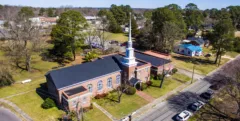
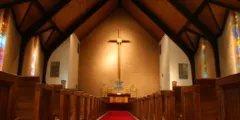
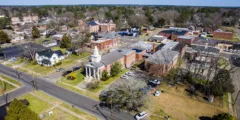
On a warm summer afternoon at the 140-year-old Saluda United Methodist Church (UMC) in Saluda, North Carolina, you might find three young boys peeking into a refrigerator for a cooling snack. The ladies of the church keep a special shelf stocked just for the boys, who live next door in a foster care home that the church owns.
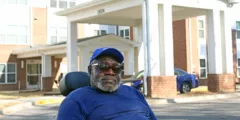
“We call the foster house the ‘impossible house,’ because it shows us what we can do when we all lean in together,” said Rev. Rob Parsons, who leads Saluda UMC and a new church called WithALL in nearby Columbus. Both churches are in in Polk County, which has a population of about 20,000 – 3,000 of whom are under age 18.
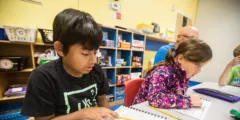
Through programs like Bridging Families in North Carolina, children in foster care can live in homes with professional foster parents, who are trained, supervised and paid by child welfare organizations like Crossnore Communities for Children (Crossnore). But the need for foster homes in Polk County far outpaces the supply, with some 45 – 52 children in care at any given time. That means many children are placed in care outside the county and away from everything familiar to them.
An “Impossible” Opportunity
Parsons was already familiar with foster care before the “impossible” became possible – both he and his wife were trained as foster respite care providers in 2015. They were also familiar with the multifaceted roles that churches can play in the lives of a community, particularly its children. He began to see a stronger connection between foster care and church ministry when Saluda UMC participated in Congregations for Children in 2016, a pilot program supported by The Duke Endowment that brought schools, churches and communities together to provide reading support for students during the school year. Parsons was awed by that experience. “The capacity that we have as a congregation and community when we stand shoulder-to-shoulder and pull in the same direction just blew me away,” he said.
In 2020, he began talks with Kim Wilson, a program director at Polk County Department of Social Services, about the need for foster care support. WithALL joined with Saluda UMC and other area churches to create a child advocacy center at the former Columbus UMC. Through his involvement in various local task forces to support families and children in crisis, Parsons began to explore potential sites for professional foster care homes and initiated discussions with Crossnore Communities for Children about a potential partnership with Bridging Families™ a family-focused and team-based model of care designed to directly address the obstacles to family reunification. Bridging Families began in 2020 with support from The Duke Endowment. As of January 2026, the program had successfully reunited 34 children with their families and secured other permanent placements for 8 more. In 2024, the North Carolina Department of Health and Human Services selected Bridging Families as the state model for professional foster parenting.
Possibility Through Partnerships
When the property next door to Saluda UMC became available for $371,000 in November 2022, Parsons and his congregation were ready to take a chance. The church worked with long-time Endowment partner Wesley Community Development (Wesley CDC), which helps churches in both United Methodist Church conferences in North Carolina examine and reimagine their use of real estate for creative ministry. Wesley CDC facilitated favorable purchase terms that helped the church to feel comfortable buying the property. A $200,000 anonymous donation helped defray the cost of purchase. The congregation pledged to raise funds as well. The United Methodist Foundation of Western North Carolina agreed to hold the mortgage on the house, which Saluda UMC repays through the rental income received from Crossnore. Crossnore provides professional foster parents and placements for up to five children at a time. Another regional funder, Dogwood Health Trust, provided funds to rehabilitate and upgrade the 100-year-old house. Since the first residents moved in at the end of 2023, the home has served five children in two families. One of those families has been successfully reunited.
Strengthening Church, Family and Community Relationships
“The idea started at our sister church, WithALL, as part of a broader approach to supporting children and families,” Parsons said. “But it took the old church’s stability to actually secure the house. And this whole thing only works because of the relationships we’ve built in the community.”
WithALL is now looking for other properties to support foster care housing, and Saluda UMC has doubled the size of its weekly worship attendance.
“This is the most fun I’ve had in my ministry for 30 years,” Parsons said. “As one new member of our congregation recently said, “I’ve been looking for a church for a long time that is doing something bigger than itself’.”