Connecting Children with Family, Safety and Belonging
HALOS
When parents are unable to care for children, relatives or family friends often step up to raise them in a relationship known as kinship care. In the Charleston, S.C., region, HALOS offers supports, services and connection to resources for kinship caregivers and children.
“Most of us don’t know the challenges that exist when a grandparent, (or) an aunt and uncle, step in and simply don’t have the resources to take care of a child,” says Jed Dews, executive director of HALOS. “HALOS is an organization dedicated to comprehensive and effective services for kinship families, making sure that adults who step up and raise relative children have the support they need to be successful.”
HALOS offers an evidence-based Kinship Navigator service to connect and guide families to resources, a model pioneered at HALOS with support from The Duke Endowment.
HALOS also offers services including support groups, peer-to-peer caregiver mentorship, Success Coach-based case management, legal assistance, and basic supplies and childcare equipment. Together, the services enhance family stability by building access to legal expertise, financial sustainability, parenting and child community connection, and caregiver emotional support.
“Family has been taking care of family since the beginning of time. We know that family is the best place for a child to grow up,” Dews says.
Each year, HALOS serves approximately 700 kinship caregivers and their families in Charleston, Berkeley and Dorchester counties. Among the kinship caregivers and the children in their care, a variety of relationships are represented.
“Kinship caregivers are people that know these kids and are watching them until either things get better, or forever. They could be grandkids, nieces, nephews, even fictive kin, which is a neighbor, a family friend that’s not biologically related to them — a teacher, aunt, uncle, cousin, or close family friend,” explains Kiki Todman, HALOS staff family advocate.
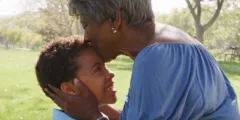
Yvonne Smith, who lives in Charleston, cares for two siblings, girls aged 10 and 7. “I just adore them. They are family to me,” Smith proclaims.
Kinship caregiving arrangements can be temporary or permanent. They range from informal (parents making private agreements) to formal (legal custody, guardianship or adoption). Many kinship caregivers assume their role following traumatic and sudden changes in the lives of the children they find in their care. As a result, big changes occur in caregivers’ lives, too, a pace and scale of change that can leave many caregivers feeling vulnerable and isolated in the face of tremendous challenges.
“A lot of our caregivers come in person two times a month for [the] support group, to talk about their experience across all fields, and to hear from both experienced caregivers and new caregivers. Our message to them is that there are so many caregivers in your situation that face similar things, and it’s really important for you to know that you’re not alone,” says Todman.
Smith credits her participation in a HALOS support group as a source of strength. “When I first started, I thought, how could I do this? It’s not always easy. You have good days. You have bad days. The people that I meet through my support group, they are all kind, caring people. If I have a problem, I can talk to them about my problem or my situation, and they are there to help me with that,” Smith says.
The Success Coach service at HALOS brings one-on-one support to kinship care families with the most complex needs. “A lot of caregivers stop thinking about themselves and they only think about the children. But then they realize, ‘I need help figuring out my goals for the future. Like what do I do next? Where do I go from here?’ Success Coach is one-on-one hands on support to plan for, and hit, your next level goals,” says Todman.
While HALOS’ services are tailored individually to each family the organization serves, the scope of the HALOS vision is scaling up across South Carolina to meet the needs of the more than 70,000 children now in kinship care and their caregivers.
Most of us don’t know the challenges that exist when a grandparent, an aunt and uncle, step in and simply don’t have the resources to take care of a child. HALOS is an organization dedicated to comprehensive and effective services for kinship families, making sure that adults who step up and raise relative children have the support they need to be successful. We offer a core model of navigation for these families, as well as a number of supportive services.
Jed Dews, Executive Director of HALOS
Experts say kinship care can be more beneficial for children than traditional foster care because kinship care lets children maintain family and familiar ties, benefit from ongoing links to their culture and continue to build social connections within the community they know. Research shows that kinship care placements cut the risk of behavioral and social challenges for children nearly in half.
In late 2023, evidence like this proving the effectiveness of HALOS kinship care services inspired South Carolina leaders to pass historic legislation and implement new policies that expand access to kinship care programs and services across the state.
As services and supports grow to meet the needs of tens of thousands of South Carolina kinship care caregivers and children, Yvonne Smith holds fast to a personal commitment.
“I was taught that when you climb the ladder, reach back and grab somebody’s hand, and carry them with you… and that’s what I’m doing,” she concludes.