Using Church Property to Provide Senior Housing
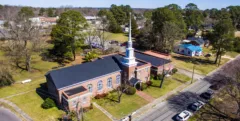
When Cole Memorial United Methodist Church (UMC) in Charlotte, North Carolina, closed in June 2018, the property reverted to the denomination’s Western North Carolina Conference. The conference looked to Wesley Community Development (Wesley CDC), which manages unused church properties for both UMC conferences in North Carolina, to help determine the best use of the property going forward. The Duke Endowment helped create Wesley CDC in 2002 to produce affordable single-family homes and has continued to support the nonprofit’s growth to include multi-family and supportive housing. Over the last several years, the Endowment has supported Wesley CDC’s work to help churches look at unused properties for new ways to engage communities.
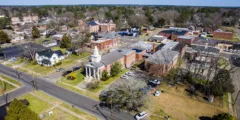
Cole Memorial had a long history, but it had lost connection with the community as the area grew and changed. Wesley CDC considered how to use the former church property to create a new ministry to meet the needs of local residents. Its prime location at the corner of West Sugar Creek Road and North Graham Street, in a growing neighborhood north of downtown Charlotte, made the property stand out to Joel Gilland, president and CEO of Wesley CDC.
“We recognized that Cole Memorial was sitting on a valuable site along a bustling transportation corridor, with two bus stops within a block. Close access to transportation would make it a perfect site for affordable housing,” said Gilland. “When we spoke with the community, housing for seniors was a clear priority.”
“Even though this project is in an urban area, we were excited by the creativity in thinking about adaptive reuse and know this same approach can serve as a model for similar thinking among rural churches, documenting lessons learned and contributing to a replicable model for this type of engagement,” said Robb Webb, director of the Endowment’s Rural Church program area.
Wesley CDC proposed, and conference leadership accepted, a recommendation to tear down the Cole Memorial UMC building and lease the grounds to a Wesley CDC subsidiary to develop affordable apartments for seniors.
Because the project was focused on providing affordable housing (defined as housing for those earning 30 percent to 60 percent of the area median income), Wesley CDC was able to secure all needed financing from just two sources: a low-income tax credit award from the North Carolina Housing Finance Agency and a loan from the Charlotte Housing Trust Fund.
Construction began on Mineral Springs Commons Senior Apartments in 2021, offering 73 affordable one- and two-bedroom units for independent living. Amenities include a community room, an open kitchen for social occasions, laundry and exercise facilities, as well as craft and computer rooms. Third parties provide home health and social events, and residents may have nurses or live-in aides who come and assist them as needed.
“Mineral Springs opened in October 2023 and filled up within three months,” said Bianca Fawcett, regional property manager at Partnership Property Management, which manages the building. “People were showing up even before we opened, and I received hundreds of inquiries. You could tell that Charlotte really needed this.”
Maintaining Connections
The apartments are designated for residents 55 and older, with an average age in the early 60s. While many are receiving Social Security or other retirement income, most are still working in the community. “Our residents work in grocery stores, airport kitchens, day care centers and as bus drivers. Some work from home, have their own businesses or help care for their grandchildren,” Fawcett said.
The apartments and amenities provide a safe space for seniors, but the greatest value comes in the form of human connection.
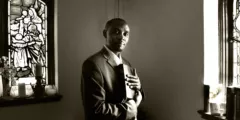
Calhoun Anderson was one of the first people to move in. “When I walked into Mineral Springs – this clean, bright, safe place – I felt privileged for the first time in my life,” he said. “I was never a ‘people person’ before I moved in here, but I love my neighbors. For an elderly person, loneliness is a terrible thing, but I’m relishing my senior years, no longer lonely anymore, surrounded by friends.”
The United Methodist Church’s ability to support these personal connections is poised to grow. The property on which Mineral Springs Commons sits includes four additional acres that the conference may choose to build upon as well. A new light rail line is expected to be developed soon, which will provide additional transportation options for residents and increase the property’s value overall.
“Because the Conference still owns the land, it is still doing ministry – just in a different way,” said Gilland.
Benefits for Seniors, Church and Ministry
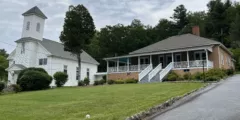
About 16 miles down the road from Mineral Springs, in suburban Gaston County, another church is prepared to tackle a new build. This one will offer 99 units of market-rate senior housing and will sit next to Park Street UMC on the church’s five-acre parcel.
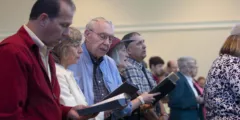
Pastor David Hiatt said the project began in 2018 when he attended Wesley CDC’s “Seeds of Change” workshop designed to help pastors and congregations rethink the possibilities for church buildings. “After that workshop, we conducted a brainstorming session one Saturday with our congregation,” he said. “We told them to go nuts and imagine whatever they could about how to use our undeveloped land for the betterment of the church and the community as a whole.”
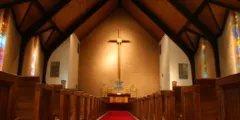
Senior housing emerged as a dominant theme in those conversations. Hiatt worked with the Wesley CDC team to determine the best way to create housing while also generating revenue to support much-needed renovations for the 70-year-old church building.
Getting from idea to groundbreaking was a somewhat arduous process. For two years, Wesley CDC navigated potential funding mechanisms, advocated for city zoning changes, and awaited water and sewer approvals for the proposed project. The city council gave its final approval in November 2025. Wesley CDC will prepare the land for construction, and Park Street UMC is partnering with Ridge Care, which will hold a 99-year ground lease, to construct and operate the apartments.
The income from the lease will allow Park Street to fund expanding ministries, such as a weekly soup kitchen, and potentially expand ministry work to serve a growing homeless population. Hiatt said the development is a win-win for the church and those it serves. In addition to supporting ministry, the 100+ new neighbors will be good prospects for joining the congregation.
“Any asset a church owns can be leveraged to do ministry and mission,” Hiatt said. “It’s easy to see how services to populations in need reflect mission and ministry in and of themselves. But another reality is that churches need finances to support mission and ministry, so anything you can do to offset those financial burdens strengthens the church in the long run. I think we’ll see this more and more.”